Studies
Studies in architecture represent undertakings not always having a built work as the immediate goal. Some are commissioned by clients, some commission talented artists,
Studies in architecture represent undertakings not always having a built work as the immediate goal. Some are commissioned by clients, some commission talented artists, some are internal studio charrettes, and various combinations of the previous! What is common is an artistic or documentary method and result of carrying out that study.
some are internal studio charrettes, and various combinations of the previous! What is common is an artistic or documentary method and result of carrying out that study.


Residential Live-Work Study
Study of a speculative house on a typical Houston lot size of 50 ft. X 100 ft. The program for this house is live-work. Physical separations between private, common, and public work are maintained, but spatial interaction is common between the two. Private sleeping and dining are secluded from the public work but common to the garden.
Le Corbusier's "The House is a Machine for Living" is a reference.


The Classical Orders
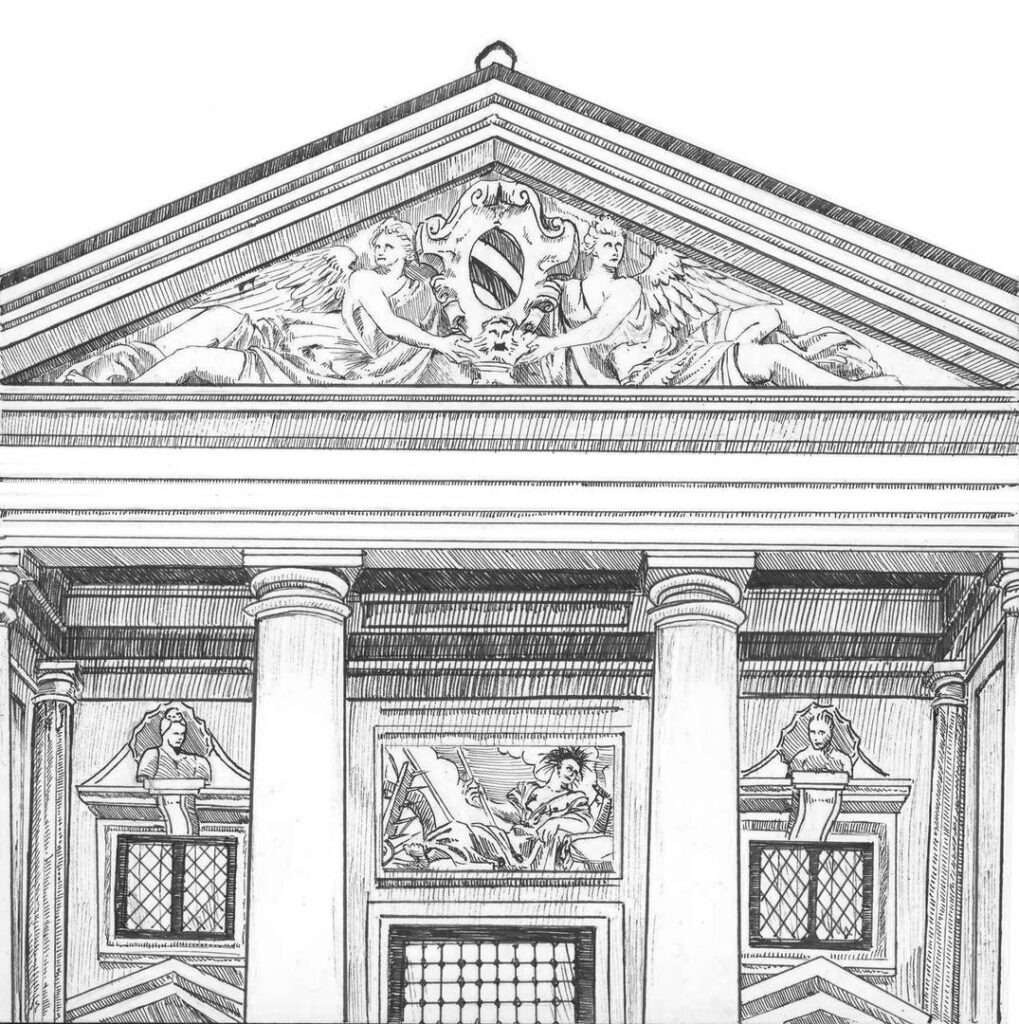
After the architect visited Europe, a study ensued to understand the major classical orders. Inspired by the myriad compositions of this vocabulary witnessed in Italy and elsewhere, the result of the study is a series of artistically rendered designs based on this vocabulary, exhibiting the study of the Tuscan, Roman Doric, and Roman Ionic orders.

Study for an Architecture School
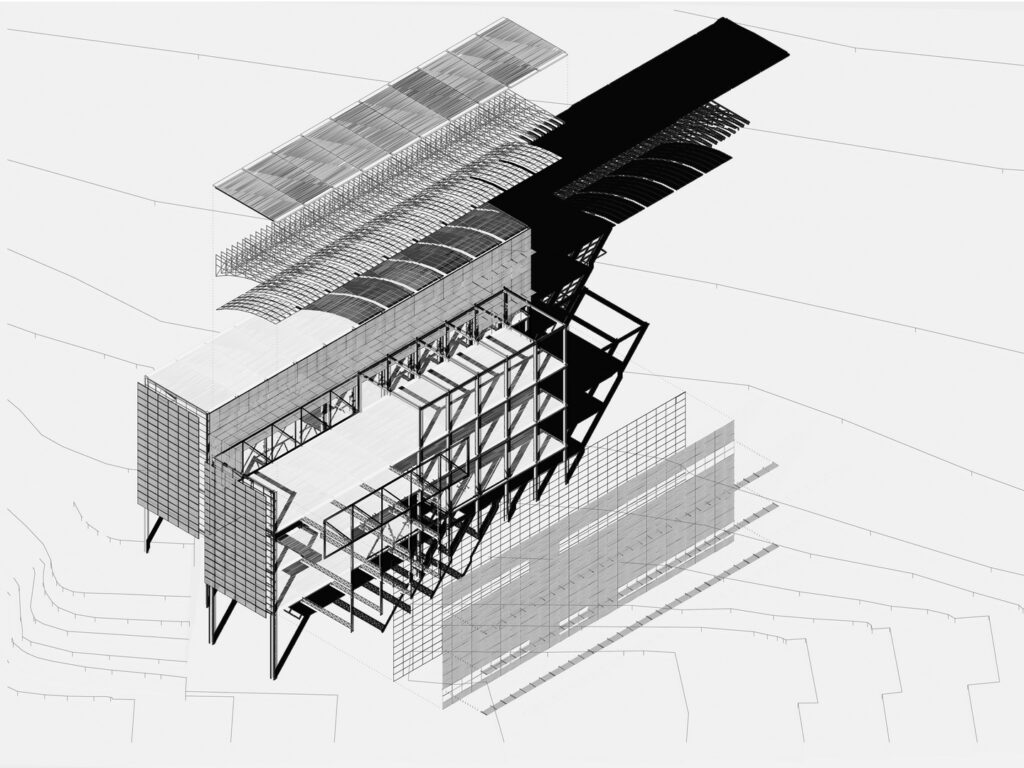
The American Institute of Steel Construction sponsored a competition for an architecture school whose program should highlight this construction material.
Steel is designed as the basic structural plan grid, as a light deflector in curved roof trusses fitted with fabric, as a floor truss for both floor and full story height, and as a material and light deflector for the window system.


Motel Near Galveston
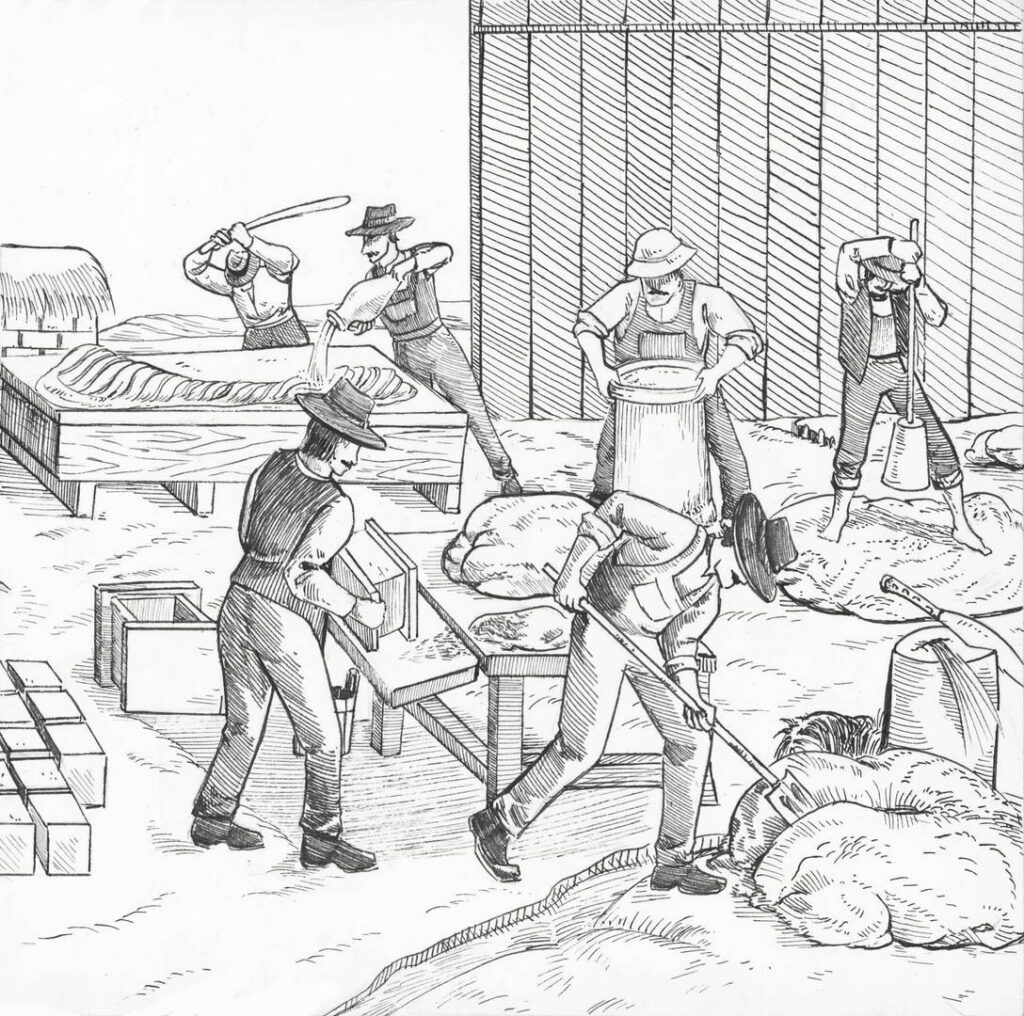
The client commissioned the firm to undertake a study for a tropical setting motel on a small land tract. Further, the style and color scheme should be inspired by Victorian motifs and bright colors, as historically built in nearby colonial islands.
The final result is a series of artistic renderings and design drawings (not shown) for continued promotional purposes.

The Four Causes
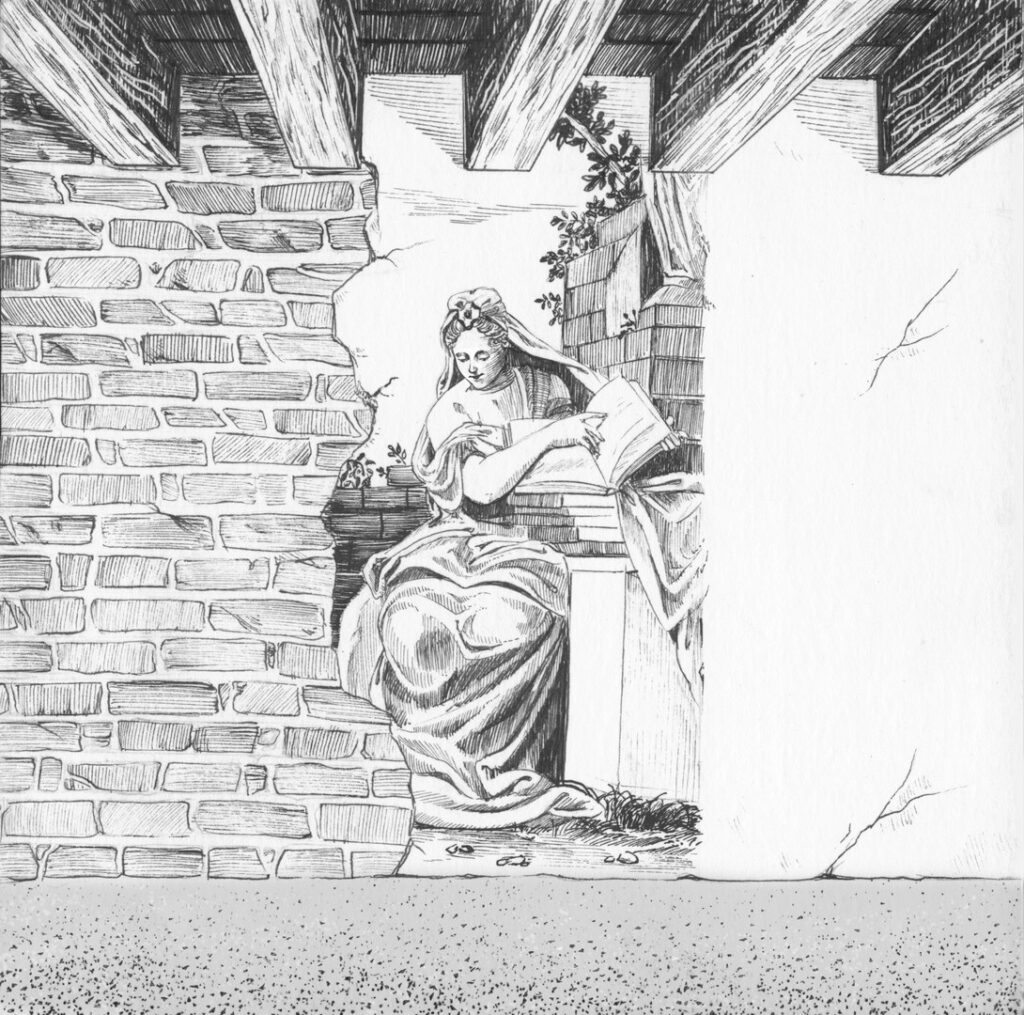
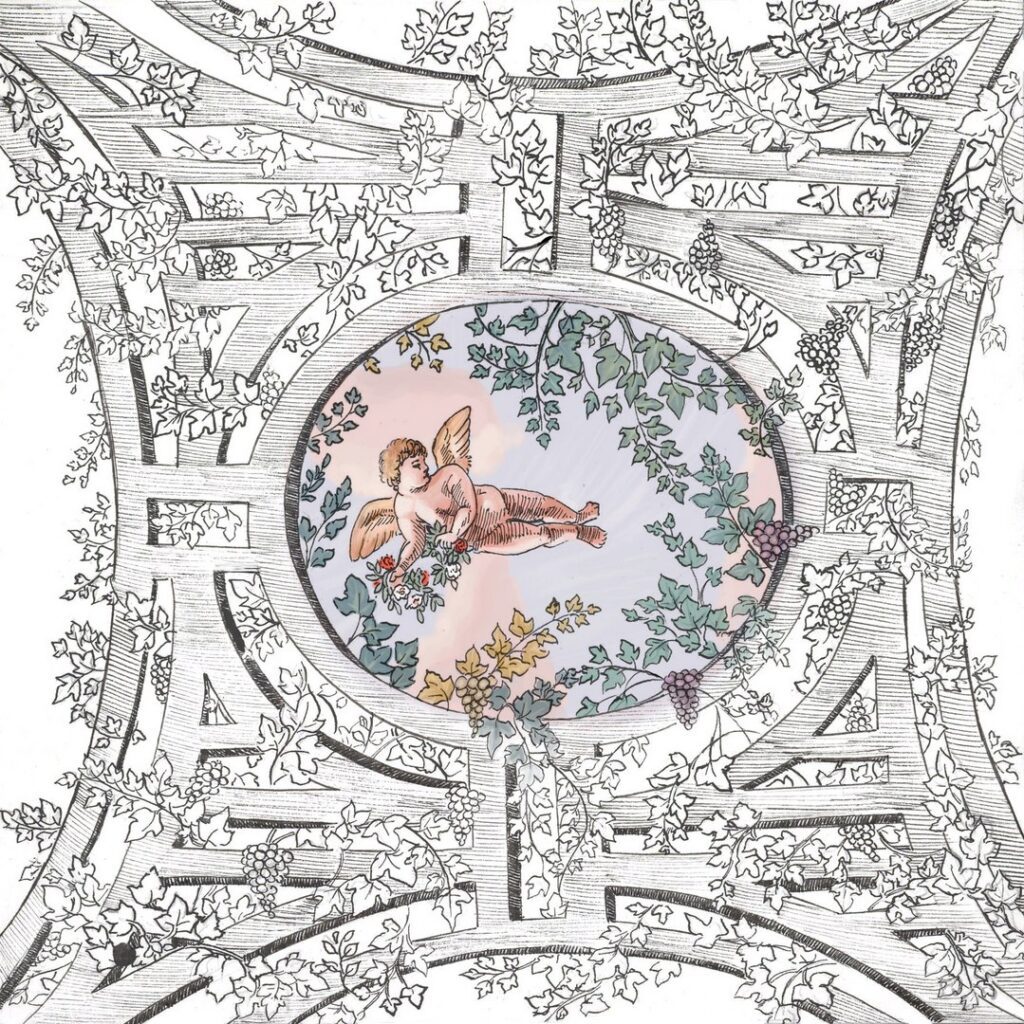
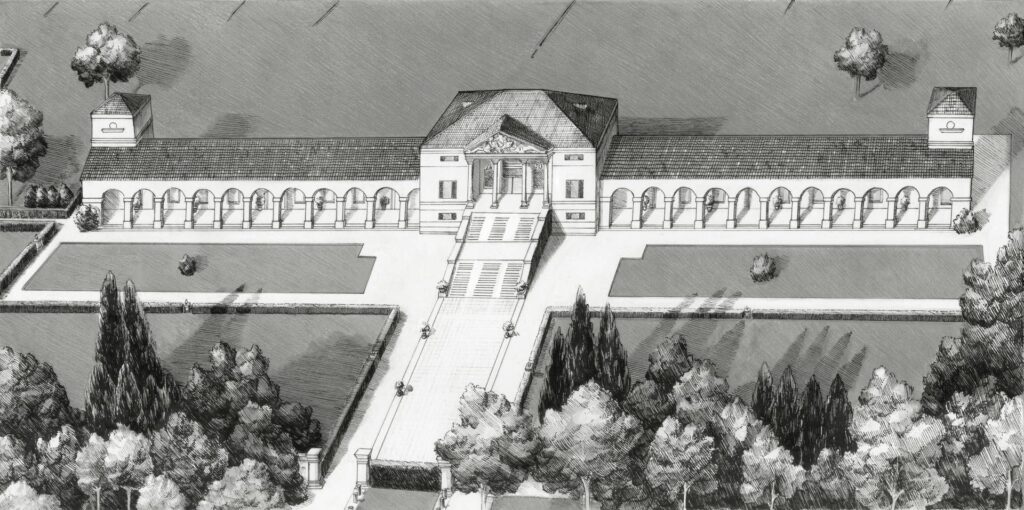
The Villa Emo, designed by Andrea Palladio and located in Italy, is the subject of these artistic renditions, composed by repeat artistic collaborator Madison Brake.
She undertook a study of the Villa and reproduced an aerial view in various media, shown here in ink and in pencil.
Details of the Villa are drawn, showcasing the idea of the Four Causes as they exist in the Villa.
This series of illustrations, both aerial and detailed, supplies the visual support for the article written by the architect, whose content is the Four Causes, and was nationally published in the periodical Palladiana in 2021 (page 8 of the periodical).


EaDo Revitalization on Buffalo Bayou
This study comprises a revitalization initiative of Eado (East Downtown). The speculative site is a naturally formed island within the Buffalo Bayou waterway system.
The industrial surroundings are incorporated into a modern aesthetic junxtapositioning parkland, entertainment venues, and an artificial interface with the bayou.

The Four Causes Explaining the Making of a Tool
SELF PUBLISHED, November, 2018
Author: Paul Benavente
Artist: Madison Brake
This article explains the four underlying principles that define our artificial environment. To begin this journey, let us enter the workshop of a woodworking craftsman and consider the working of these principles in his making of the most elemental object of the constructed world: the tool; specifically a specialized type of hammer known as the Joiner's Mallet.
The Underlying Principles of All Things Made
THE FOUR CAUSES EXPLAINING THE MAKING OF A TOOL
Author: Paul Benavente | Stella Maris Architecture | November 21, 2018
Illustrations: © 2018 Madison Brake | brakemadison@gmail.com
The previous article explained the four underlying principles that define our natural and artificial environment. These principles revolve around the general inquiry we ask when considering an object: "WHY?" Why is an object such a way or why did it change into such a way? This question of why is an inquiry of cause and there are four of them: Material, Formal, Efficient, and Final. We first illustrated these causes as they exist in the natural environment using the example of an oak tree; for as art imitates nature, we must first learn the masterful display of these causal principles in nature to implement them well in art. Therefore, let us now begin to understand how these causal principles exist in the artificial environment in the objects we create within the architecture and construction professions.
To begin this journey, let us enter the workshop of a woodworking craftsman and consider the working of these principles in his making of the most elemental object of the constructed world: the tool; specifically a specialized type of hammer known as the Joiner's Mallet.

Extrinsic Causes
Causes that exist without an object
FINAL CAUSE
That for the sake of which something is made or exist.
This tool was conceived for the purpose of facilitating his woodworking craft in the driving of his chisels and the tapping of joints in such a way as to prevent marring to both the chisels and the mallet itself.
In the craftsman's consideration of the making of this tool, it is the Final Cause that commands preeminence, for he first considers for what purpose will he make this tool. That is why the Final Cause is said to be the first in the order of causality. The Final Cause is also said to the last in the order of existence, for while the craftsman initiates his work in view of an end, that end does not come into existence until the completion of the work. This end, or final cause, is what first moves the craftsman to employ the means to make this tool. This employment of means is termed the Efficient Cause.
In turn, it is the Efficient Cause that is the causality of the Material Cause and Formal Cause of the Joiner's Mallet. By means of his craft, the matter of the mallet is caused to receive the form of the mallet and by these same means, the form of the mallet is caused to inhere in the matter of the wood.
A second point to consider about the preeminence of final cause is its establishment of hierarchy in view of the end pursued. There exists an ascending order of ends, for which a project or thing is fabricated. In this scenario, let us say the craftsman is commissioned to build all the cabinetry for a house. His order of thinking may be a consideration of the storage for the house and would descend to the joiner's mallet in the following manner: for the sake of providing the storage, cabinetry will be constructed, of which, cavities and drawers shall accommodate storage. For the sake of assembling these drawers, the technique of dovetail joinery shall be employed. For the sake of fashioning this joinery into wood, chisels shall be used; and for the sake of driving these chisels and tapping the joints of the drawers together, a joiner's mallet shall be wielded.
A third way that the Final Cause commands preeminence is in how the consideration of the end or purpose of the joiner's mallet shall inform and shape the other causes. This purpose, driving these chisels and tapping the joints, shall influence the selection of the means, form, and material for the realization of this mallet.

EFFICIENT CAUSE
That by which something is made or exist.
The Joiner's Mallet is principally produced by the application of the art of woodworking skills by the master craftsman.
Having established why this joiner's mallet shall be made, the craftsman will initiate the means to make it. The craftsman possesses the art of woodworking skills as his trade and his employment of this art will be be the means he utilizes to make the joiner's mallet. By specifying the art rather than the craftsman, we distance the making from psychological factors such as desires, intentions, and beliefs found in the craftsman as causes of the tool and instead focus on that which is also found in the craftsman and which more aptly describe the principle Efficient Cause of the tool. For the art of woodworking found in the craftsman and manifested in his making will describe the whole process and methods that make this mallet; beginning with the first selective cuts of the wood to the last expertly joining together of the head to the handle.

Intrinsic Causes
Causes that exist within an object
FORMAL CAUSE
That into which something is made or exist.
The universal "whatness" of a thing - not the form, shape, or outline, but the thing's essence. The Joiner's Mallet's essence may be defined as follows: a type of hammer composed of wood used in woodworking for the driving of chisels or tapping of joints. Note how the final cause defines its essence.
By this art of woodworking skills shall the craftsman begin to inhere the form of the joiner's mallet into the wood. The craftsman has in his mind an idea of the mallet before he begins and this idea is known as an Exemplar of the mallet. This Exemplar is a special mode of Formal Cause known as Exemplary Cause and its difference is that it exists extrinsically to the mallet, being in the craftsman's mind. At completion, when the idea of the mallet exists intrinsically to the mallet, then we can truly say that the joiner's mallet is the Formal Cause of the object.
The Formal Cause is the form, the essence, the whatness of an object. It is those various abstractions of toolness and hammerness, driving of chisels, and tapping of joints that are invested into this object and give this object Form. And we give precision to these abstractions which together make this object in what is called the definition - the intelligible expression of a thing's quiddity (whatness). The formula of the definition, like a formula for an medicinal elixir composed of various substances, is composed of these various abstractions, which together unite to define this joiner's mallet. Although this formula may describe various parts - generic, material, and specific - of this mallet, it is not the toolness (generic) or wood (material) that principally describes the essence of the mallet, but its specific hammerness and its driving of chisels and tapping of joints. It must be emphasized how the essential characteristics of this object are those of its Final Cause or purpose. The purpose of the mallet principally animates the form; clarifies the essence of the joiner's mallet.
For the essence of the joiner's mallet is said to be perfect when it communicates a perfection to another, which it does in the attainment of its end or final cause; the driving of chisels and tapping of joints. And the more perfectly the material, formal, and efficient cause attain this perfection, the more perfect may we say this joiner's mallet is.
This questioning of what is an object's essence and to what perfection is this essence ordained is crucial in the undertaking of this simple tool and even more so in the undertaking of more complex works of art such as architecture.

MATERIAL CAUSE
That out of which something is made or exist.
The Joiner's Mallet must be made of a dense wood material, of which maple, cedar elm, osage orange, and oak are appropriate.
MATERIAL CAUSE
Similar to Formal Cause, by this art of woodworking skills, shall the craftsman begin to cause the wood to receive the form of the mallet; not the shape only, but the whole essence of the mallet. The matter or material cause; therefore, is fundamental for this tool's existence. The final cause, or purpose, shall inform the craftsman's consideration of the appropriate matter for the mallet. A moderation is in order, for the if the material be too hard such as a tool of steel, it will damage the chisel and the wood being assembled. And if the material be too soft such as pine or douglas fir, the mallet itself will be damaged in its use. Rather, a hardwood of remarkable density, such as maple, cedar elm, or oak, will do.
In summary, the craftsman first conceives of the need for the joiner's mallet in the context of the larger project of building the cabinetry for a house. The specific purpose (Final Cause) of the joiner's mallet, the driving of chisels and tapping together of joints, is the first cause that moves him to initiate making this mallet; and this same purpose influences the other causal principles of the mallet. He moves to apply his art of woodworking skills to effect (Efficient Cause) the idea he has of this mallet, the Exemplar in his mind, into the matter of the oak wood (Material Cause) out of which the form (Formal Cause) of the joiner's mallet is finally born and the purpose of this tool is finally achieved. In that; the dictum about Final Causality, first in causality and last in existence, is fulfilled.

The Underlying Principles of All Things Made
SELF PUBLISHED, October, 2018
Author: Paul Benavente
Artist: Madison Brake
An article illuminating the most basic principles of the built environment by first identifying these principles in the natural world in order to animate the understanding of the dictum "art imitates nature."
ANCIENT WISDOM FOR ARCHITECTS, INTERIOR DESIGNERS, BUILDERS, DEVELOPERS, CRAFTSMEN, PLANNERS, ENGINEERS, AND OTHERS
Author: Paul Benavente | Stella Maris Architecture | October 1, 2018
Illustrations: © 2018 Madison Brake | brakemadison@gmail.com
Many of us are either in the business of making things or hiring someone to make something for us. We may qualify ourselves as artisans in this way and the breadth of this qualification encompasses virtually every occupation in the architecture and construction industry from the carpenter customizing cabinetry to the college professor shaping future architects to the urban planner laying out our neighborhoods and cities.
But what are the underlying fundamental principles of this making? Can we benefit from knowing these principles that our own making be more conscious and conscientious? This first in a series of articles, to be published on a periodic basis, will convey these principles and illustrate them as found in nature. Following the dictum art imitates nature, subsequent articles will illustrate and discuss these principles as found in the various disciplines of architecture and construction, the artificial environment.
By artificial environment, we refer to anything made. Therefore, let us first consider what it means to be a maker of things, an artisan. An artisan is the maker of art and art is defined as follows:
Art - Right reason in things to be made
This right reason refers to an artisan's good education in the correct principles of his art or practice in order to make things well. What, we ask, are the most fundamental principles that an artisan needs to know to do his or her art well? The answer to this question revolves around the general inquiry: "WHY?" Why is the artifact of the artisan made in such a way or why did it become something different than it was.
Here we are speaking of the notion of causes. Ancient philosophy and the nature of things describe four causes: material, formal, efficient, and final. These four causes, which are understood separately but act in unison, answer this question of why. They are divided in pairs into intrinsic or extrinsic to an object. Consider the following illustrations of the causes as demonstrated in nature.

Intrinsic
Causes that exist within an object
MATERIAL CAUSE
That out of which something is made or exist.
On the microscopic level, the oak tree is composed of elements - carbon, hydrogen, oxygen, nitrogen, phosphorus, and sulfur being the predominant ones.

FORMAL CAUSE
That into which something is made or exist.
The universal "whatness" of a thing - not the form, shape, or outline, but the thing's essence. We show here the acorn, which represents the essence of the oak tree, having the oak tree existing in it as a potentiality.

Extrinsic
Causes that exist without an object
EFFICIENT CAUSE
That by which something is made or exist.
Among the causes, this cause is the most easily understood and most often explained. It is the external forces acting on the thing; here, the sun, wind, water, and nutrients assimilating themselves into the sapling.

FINAL CAUSE
That for the sake of which something is made or exist.
Among the causes, this cause is the most difficult to understand and the most neglected in explanation. In natural objects, such as this oak, it is the innate directing principle of the oak, guiding it to the perfection of the form of the oak, a mature oak tree. See below for a continuation of the conversation about this cause.
An explanation about the final cause is in order because its understanding is the most elusive of the causes, yet it holds the primacy among the causes and its explanation will elucidate both the other causes and our understanding of our own creative process.
It is the most elusive for two reasons. Firstly, because it is in reality the same as the form (formal cause) of a thing or agent because every agent acts for an end and it is this acting or tendency to an end which we call final cause. This tendency will seek to acquire the perfection of an agent either as an innate directing principle in a natural object or as reasoned directing principle in man. Men act and make things in view of a perceived good aim which will contribute to a greater perfection of his own or the general populace.
From this point, we see the importance of asking ourselves the following question about the thing we are making: What is the essence of this thing and what perfection or goal is it seeking to acquire?
It is elusive, secondly, because the final cause exists first only as a potentiality and comes into existence only at the end. For example, in nature, the acorn is only potentially an oak tree; and in art, the stack of lumber is only potentially an oak table. Over time, the perfection of the form, as instilled by Divine Intelligence in the acorn or conceived by human intelligence in the lumber, will come to be by maturation or labor.
This aspect of final cause emphasizes to us the importance of having a clear and worthwhile vision of our goal from the beginning and before any activity be undertaken, as well as understanding that this vision will only become reality at the end of an often arduous path.
The final cause holds the primacy and is called the "cause of causes" because it causes the other causes and because, as explained above, it exerts its influence first. For example, a landowner conceives the end of possessing and enjoying a Victorian style home, which first moves the constructors (efficient cause) to erect and craft with fitting materials (material cause) according to a Victorian pattern described in blueprints (formal cause).
The critical question here is to ask ourselves: What is the purpose of what I am making and how does this purpose shape the materials, methods, and the very thing I am making?
A second and important consideration about the final cause concerns hierarchy. In order to arrive at an ultimate end, there exist intermediate and subordinate ends. Let us take an example familiar to all of us: human nature.
A man or woman nourishes the body to attain a healthy body to allow fitness for work. This is ordered to the procurement of material prosperity for the body and spiritual prosperity for the soul in the form of leisure, which consists in the contemplation of universal, beautiful, and good things, of which the contemplation of God is the ultimate.
An understanding of hierarchy of goals clarifies the ultimate goal and the intermediate goals. We see, from the example of man's goals, how the ultimate perfection of man defines the hierarchy of goals. From this observation, we may ask ourselves the following questions: What is my ultimate goal for a given task? What intermediate goals must I take to reach that goal? How does the ultimate goal shape the intermediate ones? Directly applied to our industry, we can see how this concept and these questions underlie project management methods such as the Critical Path Method (CPM).



The Art of Tilt-Up Wall Construction
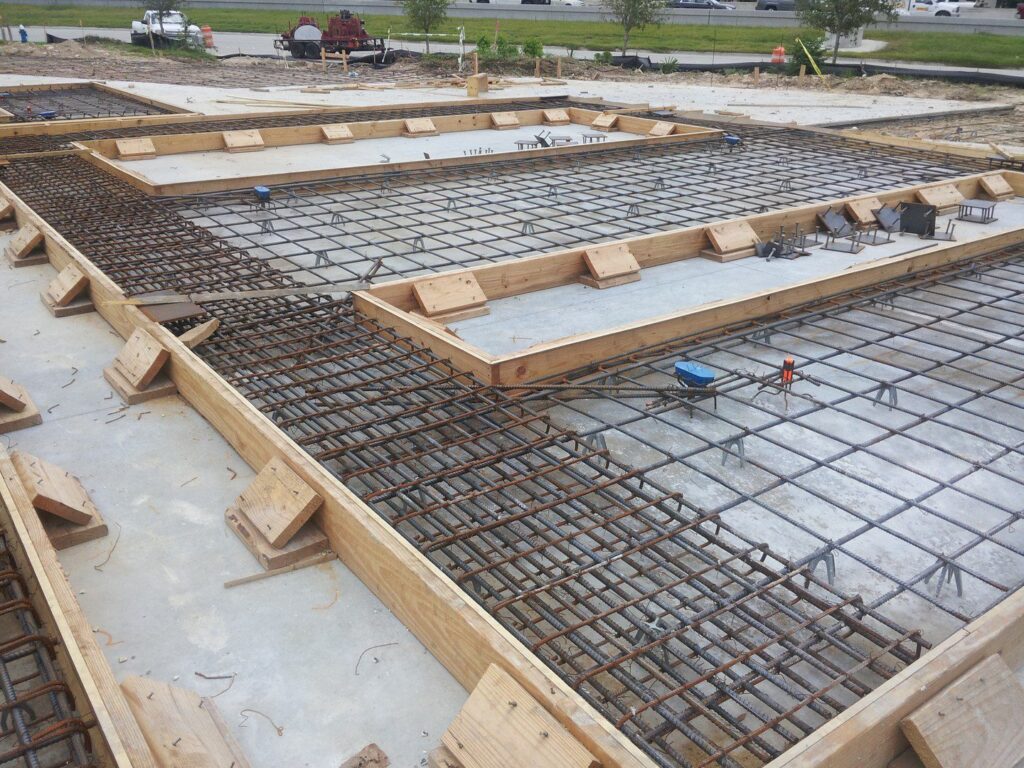
The 450-vehicle parking garage utilized a tilt-wall system for its perimeter walls. This fascinating method of construction utilizes reinforced concrete slabs poured horizontally; then lifted, or “tilted,” by a crane into a vertical orientation to thus form a wall system.
Click each image for a description of each stage of the process!
Visualization is Integral to Process
These studies enrich the culture of the firm and demonstrate the design ethic and artistry that a client may enjoin the firm. Our motto “Beauty as a Discipline of Architecture” truly shines in these studies! As often as possible we incorporate a study and its artistic accompaniment in the project.